
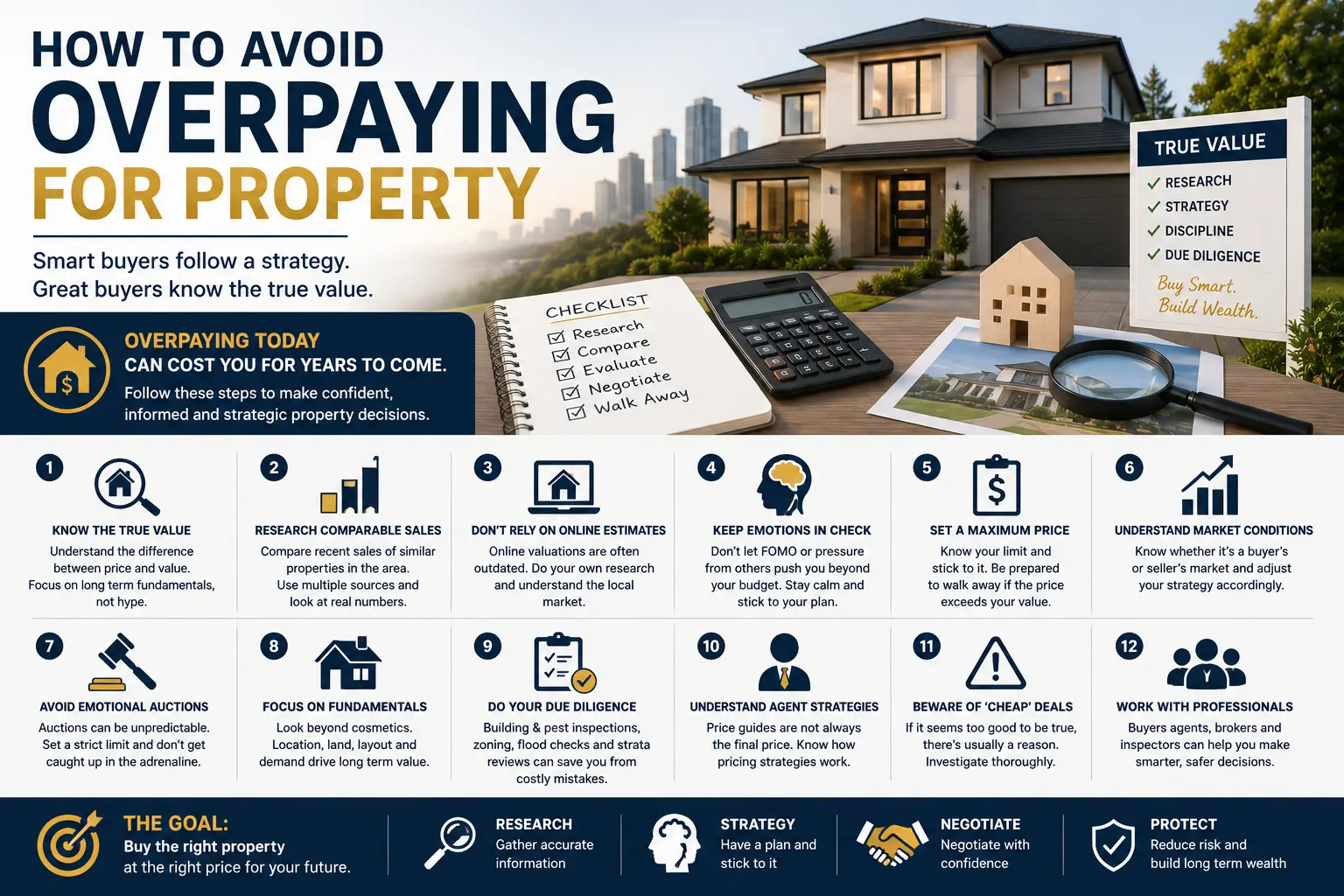
One of the biggest fears buyers have when purchasing property is paying too much.
Whether you are buying your first home or an investment property, overpaying can significantly impact:
- Long term returns
- Borrowing capacity
- Equity growth
- Cash flow
- Financial flexibility
In competitive markets, emotional pressure, media hype, and aggressive sales tactics can push buyers into making rushed decisions.
The reality is that property is worth what a qualified buyer is willing to pay at that point in time — but that does not mean every price paid is a smart price.
Avoiding overpayment is not about always buying “cheap.”
It is about understanding value, market conditions, negotiation strategy, and long term fundamentals.
Why Buyers Often Overpay
Many buyers overpay because they:
- Become emotionally attached
- Fear missing out
- Rely on poor market data
- Do not understand local values
- Rush decisions
- Compete emotionally at auctions
- Ignore due diligence
- Trust agent price guides too heavily
Property markets are emotional by nature.
The key is learning how to remove emotion from the decision making process.
1. Understand the Difference Between Price and Value
Price and value are not always the same thing.
Price
The amount someone pays today.
Value
What the property is truly worth based on:
- Comparable sales
- Location
- Land value
- Demand
- Scarcity
- Long term fundamentals
Some buyers pay premium prices for poor quality properties simply because emotions took over.
A smart buyer focuses on value, not hype.
2. Research Comparable Sales Properly
Comparable sales are one of the most important tools when assessing property value.
You should compare properties with similar:
- Land size
- Location
- Property type
- Condition
- Layout
- Bedrooms and bathrooms
- Renovation level
- Garage and parking
- Development potential
The closer the comparable properties are to the subject property, the more accurate the pricing assessment becomes.
3. Understand That Online Estimates Are Often Inaccurate
Many buyers rely heavily on:
- CoreLogic estimates
- Automated valuations
- Online portals
- Median suburb prices
The problem is these figures are often:
- Delayed
- Generalised
- Unable to account for street quality
- Unable to assess property condition
- Unable to assess buyer demand in real time
Two properties in the same suburb can vary significantly in value.
On the ground research matters far more than automated estimates.
4. Do Not Let Fear of Missing Out Control You
FOMO is one of the biggest reasons buyers overpay.
This usually happens when:
- Multiple buyers are competing
- Auctions become emotional
- Agents create urgency
- Media headlines create pressure
When emotions rise, logic often disappears.
Buyers start thinking:
- “I have to win”
- “I will never find another property”
- “The market will keep rising forever”
This mindset can lead to paying tens of thousands more than necessary.
5. Set a Maximum Price Before Negotiating
One of the best ways to avoid overpaying is to establish your walk away price before negotiations begin.
This price should be based on:
- Comparable sales
- Market conditions
- Your financial position
- Long term value
- Property quality
Once you reach your limit, walk away.
There will always be another opportunity.
Discipline protects buyers from emotional overspending.
6. Understand Local Market Conditions
Different markets require different strategies.
In a Hot Market
Properties may:
- Sell quickly
- Have multiple offers
- Require stronger terms
- Sell above guide prices
In a Slower Market
Buyers often have:
- More negotiation power
- Better contract conditions
- More time for due diligence
Understanding supply and demand gives buyers an advantage during negotiations.
7. Avoid Emotional Auctions
Auctions are specifically designed to create emotional competition.
Many buyers exceed their budgets because:
- Adrenaline takes over
- Competitive pressure increases
- They become focused on “winning”
A property should never become a financial burden simply because emotions took control at auction.
If attending an auction:
- Set a strict limit
- Remain unemotional
- Understand the property’s true value
- Be prepared to walk away
8. Focus on Investment Fundamentals, Not Cosmetic Presentation
Many buyers overpay because they are influenced by:
- Furniture styling
- Renovated kitchens
- Fancy lighting
- Cosmetic upgrades
Presentation matters, but fundamentals matter more.
Strong long term value usually comes from:
- Location
- Land value
- Scarcity
- Demand
- Layout functionality
- Owner occupier appeal
Cosmetic presentation can distract buyers from underlying issues.
9. Complete Proper Due Diligence
Overpaying is not just about price.
It can also mean purchasing a property with hidden risks.
Always complete:
- Building inspections
- Pest inspections
- Flood checks
- Strata reviews
- Zoning reviews
- Rental assessments
- Comparable sales analysis
A property may appear attractive initially while hiding costly problems.
10. Understand Agent Pricing Strategies
Many buyers misunderstand how price guides work.
Some properties are intentionally:
- Underquoted
- Strategically priced
- Marketed to attract competition
Price guides are not always indicators of final sale price.
This is why independent research is critical.
11. Be Careful With “Cheap” Properties
Cheap properties are not always bargains.
A property may be cheap because of:
- Poor location
- Oversupply
- Structural problems
- Low demand
- High crime
- Flood risk
- Limited growth potential
Buying a poor quality property cheaply can still become an expensive mistake.
12. Work With Professionals Where Needed
Experienced professionals can help buyers avoid costly mistakes.
This may include:
- Buyers agents
- Mortgage brokers
- Conveyancers
- Building inspectors
- Accountants
An experienced buyers agent can often help:
- Assess true market value
- Negotiate strategically
- Remove emotion
- Access off market opportunities
- Avoid poor quality stock
Common Signs a Buyer May Be Overpaying
- The property has attracted emotional competition
- Comparable sales do not support the price
- The buyer has stretched beyond comfortable affordability
- The purchase decision feels rushed
- Due diligence was skipped
- The property is being justified emotionally rather than logically
These are often warning signs that buyers should slow down and reassess.
Why Long Term Thinking Matters
Property should generally be viewed as a long term asset.
Paying slightly above market value for:
- A high quality property
- In a strong location
- With long term demand
May still perform well over time.
However, significantly overpaying for:
- Poor quality assets
- Weak locations
- Oversupplied markets
Can create long term financial consequences.
The goal is not simply buying property.
The goal is buying quality property at a fair and sustainable price.
Final Thoughts
Avoiding overpayment comes down to:
- Research
- Strategy
- Discipline
- Negotiation
- Understanding value
- Removing emotion
The best buyers are usually:
- Patient
- Informed
- Strategic
- Financially disciplined
Property markets will always have hype, pressure, and emotional competition.
The buyers who perform best long term are those who focus on fundamentals rather than emotion.
Need Help Avoiding Overpaying in the Market?
At WHY Property Investment, we help buyers identify quality opportunities through strategic research, on the ground inspections, negotiation, and detailed due diligence.
Our focus is helping clients avoid emotional decisions, reduce risk, and secure properties aligned with long term value and investment fundamentals.