
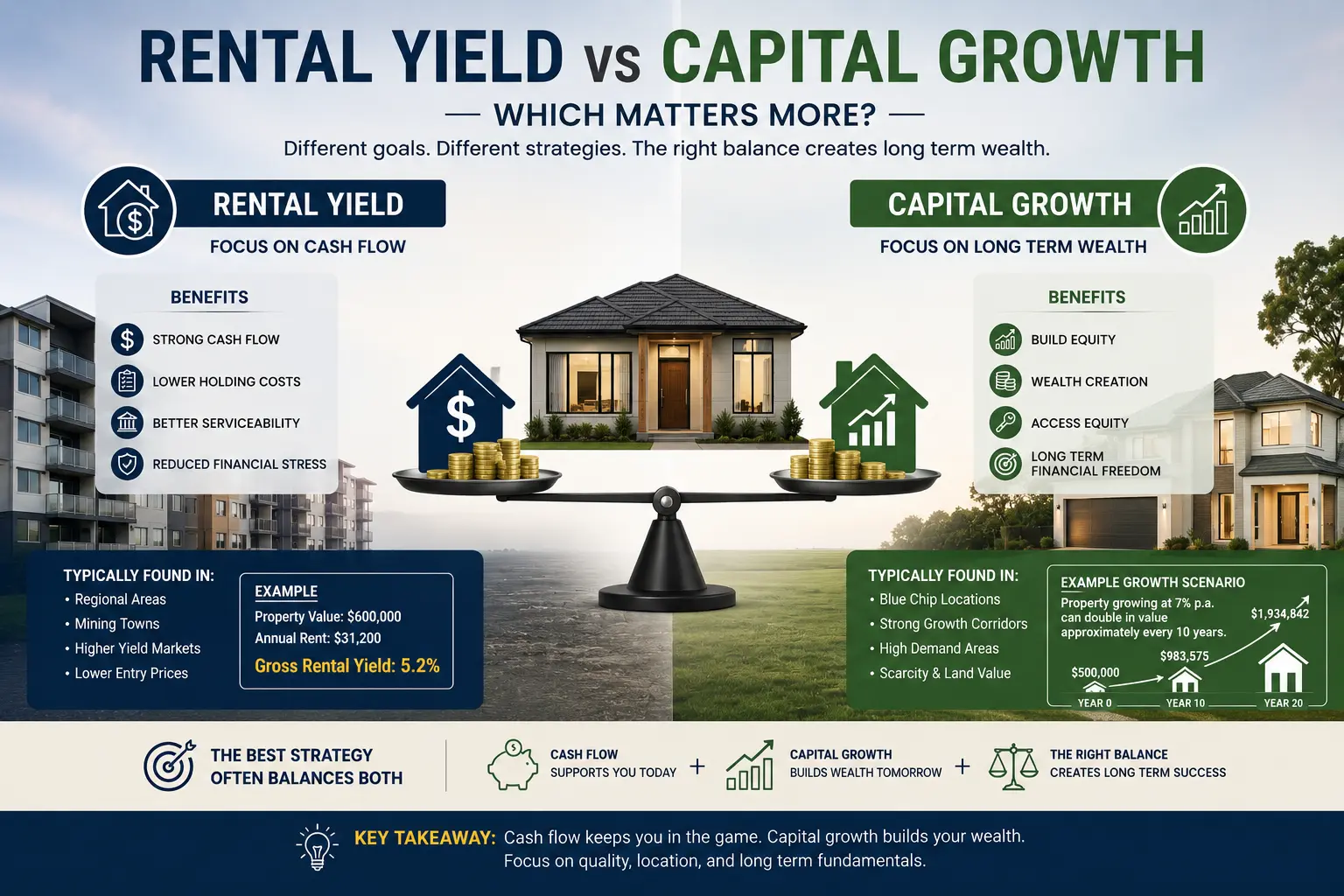
One of the most common questions property investors ask is:
“Should I focus on rental yield or capital growth?”
The answer is not always straightforward because both play important roles in building a successful property portfolio.
Some investors chase high rental returns for immediate cash flow, while others focus heavily on long term capital growth to build equity and overall wealth.
The reality is that the best investment strategy often depends on:
- Your financial position
- Income levels
- Borrowing capacity
- Risk tolerance
- Long term goals
- Stage of life
- Portfolio strategy
Understanding the difference between rental yield and capital growth is critical before making any investment decision.
What Is Rental Yield?
Rental yield measures the annual rental income a property generates relative to its value.
It helps investors understand the cash flow performance of a property.
Gross Rental Yield Formula
Gross Rental Yield = (Annual Rental Income ÷ Property Value) × 100
Example
- Property value: $600,000
- Weekly rent: $600
- Annual rent: $31,200
Gross rental yield:
(31,200 ÷ 600,000) × 100 = 5.2%
Higher rental yields generally mean:
- Stronger cash flow
- Lower holding costs
- Better serviceability
- Reduced out of pocket expenses
What Is Capital Growth?
Capital growth refers to the increase in a property’s value over time.
Example
- Purchase price: $600,000
- Value after 10 years: $1,000,000
Capital growth:
$1,000,000 – $600,000 = $400,000
Capital growth is what builds long term equity and wealth.
Strong capital growth allows investors to:
- Access equity
- Purchase additional properties
- Increase net worth
- Improve financial flexibility
For many investors, long term wealth is created primarily through capital growth rather than cash flow alone.
Why Some Investors Focus on Rental Yield
High rental yield properties are popular because they can help reduce financial pressure.
These properties often:
- Generate stronger cash flow
- Require less monthly contribution
- Improve borrowing serviceability
- Reduce holding stress during rate rises
High yield properties are often found in:
- Regional areas
- Mining towns
- Lower socioeconomic locations
- Smaller unit markets
- Higher risk locations
The Advantages of High Rental Yield
Improved Cash Flow
Higher rent can offset mortgage repayments and holding costs.
Easier Portfolio Holding
Cash flow can help investors hold multiple properties longer.
Reduced Financial Pressure
Particularly important during periods of rising interest rates.
Better Serviceability
Lenders assess rental income when calculating borrowing capacity.
The Risks of Chasing Yield Alone
One of the biggest mistakes investors make is chasing high yield without considering long term growth fundamentals.
A property may have:
- Strong rental return
- Cheap entry price
- Attractive cash flow
But still perform poorly long term.
Some high yield areas experience:
- Low population growth
- Weak owner occupier demand
- Oversupply
- Limited infrastructure
- Volatile economies
- Poor resale demand
A property with high cash flow but little capital growth may not significantly build wealth over time.
Why Many Investors Prioritise Capital Growth
Capital growth is what creates long term equity.
Even moderate growth compounded over time can create significant wealth.
Example: The Power of Capital Growth Over Time
A property growing at an average rate of 7% per year can potentially double in value approximately every 10 years due to the power of compound growth.
| Year | Property Value |
|---|---|
| Purchase Price | $500,000 |
| After 10 Years (Approx.) | $983,575 |
| After 20 Years (Approx.) | $1,934,842 |
This example highlights why many long term investors focus heavily on quality properties in strong locations with solid long term growth fundamentals. Even moderate annual growth can create significant wealth over time through compounding.
The Power of Compounding Growth
Many experienced investors focus heavily on:
- Land value
- Scarcity
- Owner occupier demand
- Infrastructure
- Population growth
- Long term desirability
Because these factors often drive stronger capital growth over time.
A property growing by:
- $80,000 to $120,000 per year in value
Can often outweigh:
- Slightly weaker short term cash flow
This is where long term wealth is usually created.
The Downsides of Focusing Only on Capital Growth
Growth focused properties can sometimes:
- Have lower rental yields
- Create larger holding costs
- Require stronger incomes to hold
- Reduce short term cash flow
Some investors become asset rich but cash flow poor.
This can create financial stress if:
- Interest rates rise
- Vacancies occur
- Personal income changes
Strong growth alone is not enough if the investor cannot comfortably hold the property.
Which Strategy Is Better?
The answer depends on your goals and financial position.
Investors Focused on Wealth Creation
Often prioritise:
- Capital growth
- Scarcity
- Strong locations
- Long term fundamentals
Investors Focused on Cash Flow
May prioritise:
- Higher yield
- Lower holding costs
- Serviceability improvements
- Portfolio sustainability
The Best Strategy Often Balances Both
The ideal investment property often sits somewhere in the middle.
Many experienced investors look for:
- Reasonable rental yield
- Strong long term growth potential
- Manageable holding costs
- Strong owner occupier appeal
This balance can provide:
- Portfolio sustainability
- Long term equity growth
- Improved flexibility
Why Location Matters More Than Yield Alone
A strong location can often outperform a higher yielding property over the long term.
Properties in desirable areas tend to benefit from:
- Higher demand
- Stronger competition
- Better resale appeal
- Population growth
- Infrastructure spending
This is why many blue chip locations have:
- Lower yields
- But historically stronger capital growth
Common Investor Mistakes
Chasing Extremely High Yield
Very high yield properties can sometimes indicate higher risk markets.
Ignoring Holding Costs
Some growth properties become difficult to hold long term.
Focusing Only on Cheap Properties
Cheap properties are not always strong investments.
Buying Based on Tax Benefits Alone
Negative gearing should never be the only reason to buy a property.
Ignoring Owner Occupier Appeal
Owner occupiers often drive long term capital growth.
What Most Successful Investors Understand
Most experienced investors understand that:
- Cash flow keeps you in the game
- Capital growth builds wealth
You generally need both working together over time.
The key is finding properties that:
- Fit your financial position
- Match your risk profile
- Support long term portfolio goals
Final Thoughts
The debate between rental yield and capital growth is not about choosing one or the other completely.
Both matter.
Rental yield helps support cash flow and holding ability.
Capital growth is what typically creates long term wealth and equity.
The best investment strategies usually involve balancing:
- Sustainable cash flow
- Strong long term fundamentals
- Quality asset selection
- Risk management
- Long term thinking
Every investor’s situation is different, which is why strategy matters more than chasing generic headlines or “one size fits all” advice.
Need Help Building the Right Investment Strategy?
At WHY Property Investment, we help investors identify investment grade opportunities by balancing long term capital growth potential with sustainable cash flow and strategic portfolio planning.
Through on the ground research, negotiation, and detailed due diligence, we help clients focus on quality opportunities aligned with their long term financial goals.