
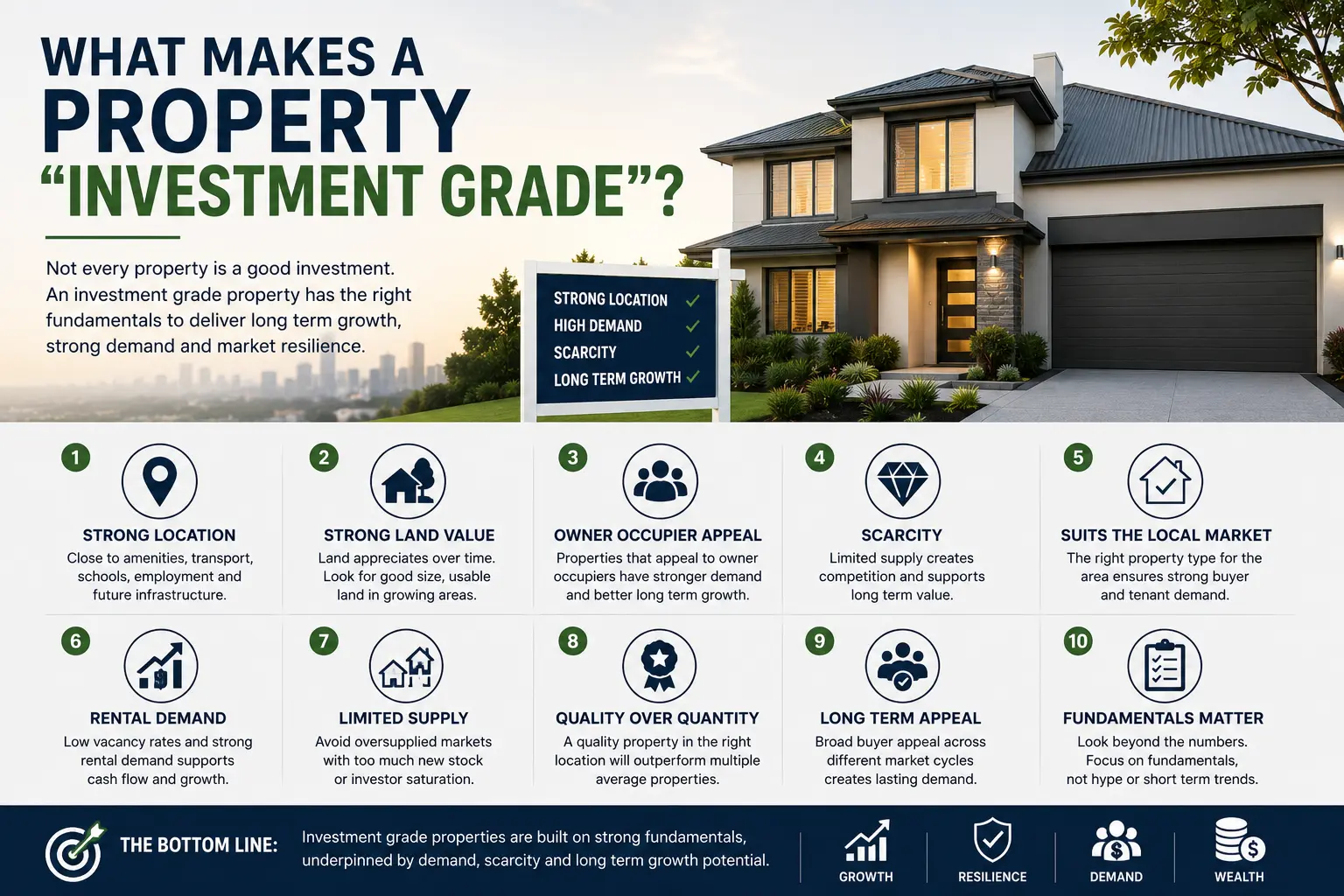
One of the most misunderstood terms in real estate is “investment grade property.”
Many properties are marketed as “great investments,” but not all properties are truly investment grade.
The reality is that a property being available for sale does not automatically make it a strong investment.
An investment grade property should have characteristics that support:
- Long term capital growth
- Strong owner occupier demand
- Market resilience
- Rental appeal
- Scarcity
- Future resale demand
The difference between an average property and a high quality investment grade property can mean hundreds of thousands of dollars over time.
Understanding what separates investment grade properties from the rest of the market is critical for long term investing success.
What Does “Investment Grade” Actually Mean?
An investment grade property is typically a property that has:
- Strong long term growth potential
- High demand from buyers and tenants
- Limited supply characteristics
- Strong land component
- Broad market appeal
- Long term market resilience
These are the types of properties that tend to outperform over time because demand consistently exceeds supply.
Investment grade properties are generally selected based on:
- Fundamentals
- Data
- On the ground research
- Market behaviour
- Long term trends
Not hype.
1. Location Is Critical
Location remains one of the most important drivers of long term property performance.
Even an average property in a strong location can often outperform a great property in a poor location.
Strong investment grade locations often have:
- Population growth
- Infrastructure investment
- Employment opportunities
- Good transport access
- Schools and lifestyle appeal
- Strong owner occupier demand
- Low vacancy rates
- Limited land supply
The best performing locations often attract both:
- Home buyers
- Investors
This creates stronger competition and long term demand.
2. Strong Land Value Matters
Land is generally what appreciates over time.
Buildings depreciate.
This is why investment grade properties often have:
- Larger land components
- Better positioned blocks
- Scarcity value
- Development potential
- Functional land layouts
In many markets, the land component is the true driver of long term capital growth.
3. Owner Occupier Appeal Is Extremely Important
One of the biggest drivers of property growth is owner occupier demand.
Properties that appeal to owner occupiers often experience:
- Stronger competition
- Better price growth
- Better resale demand
- Greater market resilience
Features that often improve owner occupier appeal include:
- Good street appeal
- Functional floorplans
- Natural light
- Family friendly layouts
- Outdoor space
- Parking
- Proximity to amenities
Properties with broad appeal generally perform better over time.
4. Scarcity Creates Demand
Scarcity is one of the most important characteristics of an investment grade property.
The more unique or difficult a property is to replace, the stronger the long term demand can become.
Scarcity can come from:
- Location
- Land size
- Views
- Character
- School zones
- Low supply areas
- Development restrictions
- Unique property features
Oversupplied properties generally struggle to achieve strong long term growth.
5. The Property Must Suit the Local Market
Not every property type suits every suburb.
An investment grade property should align with what the local market actually wants.
For example:
- Family suburbs may favour houses with yards
- Inner city locations may favour quality apartments
- Lifestyle locations may favour low maintenance homes
Understanding buyer and tenant demand is critical.
A property that does not suit the surrounding demographic may underperform.
6. Rental Demand Still Matters
While capital growth is important, rental demand also plays a major role.
Strong investment grade properties often benefit from:
- Low vacancy rates
- Strong tenant demand
- Stable rental growth
- Broad rental appeal
Properties with poor rental demand can create:
- Extended vacancies
- Cash flow pressure
- Weaker long term performance
7. Avoid Oversupplied Markets
Oversupply is one of the biggest risks investors face.
Areas with large amounts of:
- New apartments
- House and land packages
- Investor stock
- Identical properties
Can experience:
- Slower growth
- Rental pressure
- Reduced demand
- Higher vacancy rates
Investment grade properties are generally located in areas with more balanced supply and demand dynamics.
8. Quality Over Quantity
Many investors focus on purchasing multiple cheap properties rather than buying quality assets.
The problem is:
- Cheap properties are often cheap for a reason
- Lower quality assets can underperform long term
- Maintenance costs may increase
- Resale demand may be weaker
One strong investment grade property can often outperform multiple average properties over time.
9. The Property Should Have Long Term Appeal
Property markets move in cycles.
Investment grade properties tend to hold demand across different market conditions because they appeal to a broad range of buyers.
This includes:
- First home buyers
- Families
- Professionals
- Downsizers
- Investors
The broader the appeal, the stronger the potential long term demand.
10. Numbers Alone Do Not Make a Property Investment Grade
A property is not investment grade simply because:
- It has high rental yield
- It is cheap
- It has tax benefits
- It is brand new
- It is heavily marketed
Strong investing requires looking deeper.
True investment grade selection involves understanding:
- Market fundamentals
- Buyer psychology
- Supply and demand
- Long term infrastructure
- Local trends
- Street level positioning
- Property quality
Common Mistakes Investors Make
Buying Based on Price Alone
Cheap properties are not always good investments.
Following Hype
Media headlines and social media trends can create emotional buying.
Focusing Only on Tax Benefits
Negative gearing should never be the sole reason to purchase a property.
Ignoring Location Quality
The wrong location can significantly limit long term performance.
Buying Poor Quality Stock
Not all properties within good suburbs are investment grade.
What Experienced Investors Often Focus On
Experienced investors typically prioritise:
- Strong land value
- Scarcity
- Owner occupier appeal
- Long term infrastructure
- Supply constraints
- Market depth
- Quality locations
- Long term demographic trends
They understand that wealth is generally built through:
- Quality asset selection
- Long term holding
- Strategic purchasing
Not simply buying any property available.
Why On the Ground Research Matters
Online data only tells part of the story.
True investment grade assessment often requires:
- Physically inspecting properties
- Understanding streets and pockets
- Speaking with local agents
- Assessing buyer demand
- Comparing real market activity
Two properties in the same suburb can perform very differently depending on:
- Street position
- Block quality
- Layout
- Orientation
- Surrounding homes
- Future development impact
On the ground research is often what separates average property selection from strong investment grade opportunities.
Final Thoughts
Investment grade properties are not created by marketing.
They are identified through:
- Strategy
- Research
- Experience
- Due diligence
- Understanding long term fundamentals
The best performing properties are often those with:
- Strong owner occupier appeal
- Scarcity
- Quality locations
- Strong land value
- Balanced cash flow
- Long term demand drivers
Buying the right property can significantly impact your long term financial future.
Buying the wrong property can hold a portfolio back for years.
Need Help Identifying Investment Grade Property?
At WHY Property Investment, we focus on identifying investment grade opportunities through on the ground research, strategic analysis, negotiation, and detailed due diligence.
We help investors avoid poor quality stock and focus on properties with strong long term fundamentals, owner occupier appeal, and future growth potential.